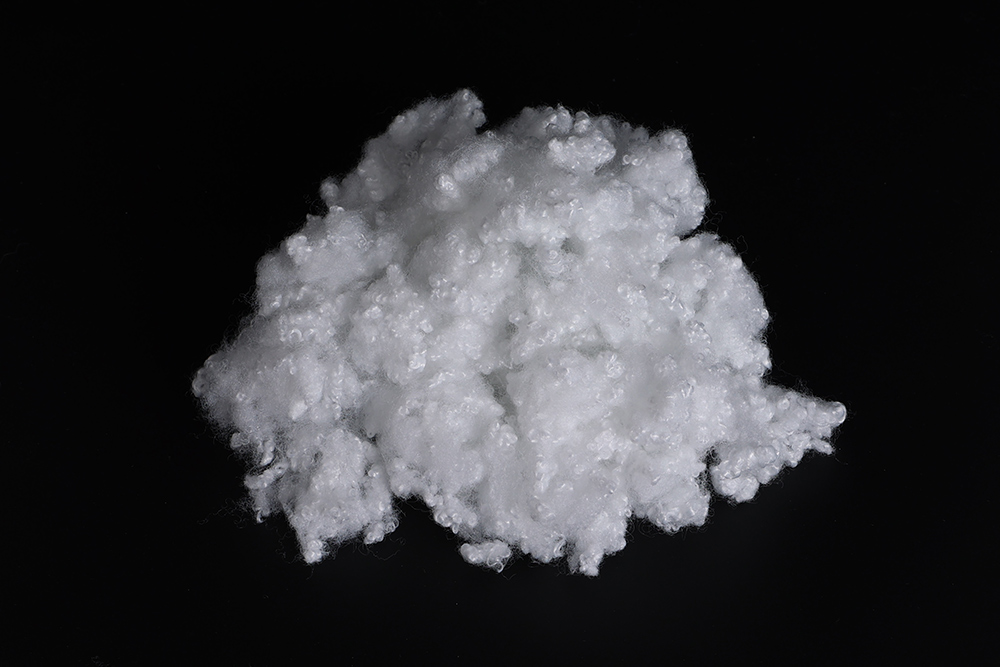
Virgin conjugate fiber is a type of bicomponent fiber composed of two polymers with different physical or chemical properties, combined into a single filament during the extrusion process. Unlike single-component fibers, conjugate fibers are engineered to achieve enhanced performance characteristics, such as improved softness, bulk, bonding ability, and resilience.
Typically, one polymer serves as a structural core, providing strength and durability, while the other forms a sheath, contributing to surface characteristics like adhesion, thermal bonding, or softness. This unique combination allows conjugate fibers to be tailored for specific applications, making them a cornerstone material in nonwoven fabrics, hygiene products, filtration materials, and advanced textiles.
Virgin conjugate fibers are specifically made from new, high-quality raw polymers rather than recycled materials, ensuring consistent properties, superior strength, and optimal processability. This distinguishes them from recycled or blended fibers, which may exhibit variable quality or performance limitations.
Virgin conjugate fiber exhibits a range of properties that make it highly valuable in industrial and consumer applications:
Thermal Bondability: The sheath polymer allows the fiber to bond at lower temperatures, eliminating the need for additional adhesives in nonwoven fabric production.
Softness and Bulk: Conjugate fibers provide a cushiony, soft feel, ideal for disposable hygiene products like diapers, wipes, and sanitary pads.
Strength and Durability: The core polymer maintains tensile strength and dimensional stability, ensuring that products withstand mechanical stress during use.
Hydrophobic or Hydrophilic Behavior: Depending on the polymer combination, fibers can be engineered to absorb or repel moisture, enhancing functionality in wipes, medical textiles, or filtration applications.
Lightweight Structure: Virgin conjugate fibers create fabrics that are strong yet lightweight, increasing comfort and reducing material usage.
These properties make virgin conjugate fibers a preferred choice in nonwoven fabric production, particularly where softness, strength, and thermal bonding are critical performance indicators.
The production of virgin conjugate fiber involves sophisticated bicomponent spinning technologies, typically through side-by-side, sheath-core, or islands-in-the-sea configurations. Each method influences the fiber's performance characteristics:
Sheath-Core Spinning: A strong core polymer is encased in a thermoplastic sheath, allowing fibers to bond during heat-based processes while retaining strength.
Side-by-Side Spinning: Two polymers are extruded next to each other, enabling the fiber to curl or crimp naturally when exposed to heat, enhancing bulk and softness.
Islands-in-the-Sea: Multiple fine filaments of one polymer are embedded in a matrix of another polymer, often used to produce ultrafine fibers for specialty applications like filtration and wipes.
Virgin conjugate fiber production emphasizes high-quality, uncontaminated raw materials, precise temperature control, and advanced spinneret design to ensure consistent fiber diameter, cross-sectional morphology, and surface characteristics. These factors collectively guarantee uniform bonding behavior, strength, and product reliability.
Virgin conjugate fibers distinguish themselves from other fiber types in several ways:
Superior Performance in Hygiene Products: Their combination of softness, bulk, and thermal bonding ability makes them ideal for disposable products, including diapers, wipes, and medical dressings.
Enhanced Nonwoven Fabric Quality: Conjugate fibers allow the creation of fabrics with uniform density, high porosity, and excellent mechanical integrity, which is difficult to achieve with single-component fibers.
Consistency and Reliability: Using virgin polymers ensures uniform properties, avoiding defects, weak spots, or inconsistent behavior often seen in recycled fiber-based products.
Versatility in Industrial Applications: From filtration media to automotive insulation and geotextiles, virgin conjugate fibers can be customized for moisture management, thermal insulation, or mechanical strength.
Eco-conscious Advantages: Although made from virgin polymers, their efficiency in production and the ability to reduce chemical adhesives contributes to a more sustainable manufacturing process.
Collectively, these factors make virgin conjugate fibers a strategic material choice for manufacturers aiming for high-performance, reliable, and innovative textile products.
Virgin conjugate fiber represents a technological leap in fiber engineering, combining the strengths of multiple polymers into a single, versatile filament. Its unique properties—softness, strength, thermal bondability, and lightweight structure—make it indispensable in hygiene, filtration, medical, and specialty textile applications. By leveraging virgin polymers and advanced manufacturing techniques, virgin conjugate fibers provide manufacturers with unmatched quality, consistency, and customization potential, solidifying their role in modern textile innovation.