The sustainability wave has reshaped procurement conversations across every industry. Recycled polyester — particularly rPET derived from post-consumer plastic bottles and textile waste — has captured the imagination of brands and buyers alike, driven by compelling environmental narratives and tightening ESG commitments.
But here is the question that every serious procurement professional must ask: when performance, consistency, and total cost of ownership are on the line, does recycled fiber actually deliver?
The answer is more nuanced than the marketing suggests. Virgin polyester fiber remains the material of choice for a wide range of critical applications — not out of inertia, but because of measurable, defensible performance advantages. This article examines why.
Virgin polyester fiber is produced through the direct polymerization of purified terephthalic acid (PTA) and monoethylene glycol (MEG) — both petroleum-derived feedstocks. The resulting polyethylene terephthalate (PET) polymer is extruded, drawn, and cut or spun into fiber with precisely controlled molecular architecture.
Because the raw materials enter the process in a chemically pure state, virgin polyester fiber has a well-defined and consistent molecular weight distribution, free from contamination, degradation byproducts, or the variability inherent in recovered waste streams. This purity is not incidental — it is the foundation of every performance advantage discussed below.
By contrast, recycled polyester (rPET) is manufactured from reclaimed feedstocks — most commonly shredded PET bottles or post-industrial textile waste — that have already undergone one or more thermal and mechanical processing cycles. Each cycle degrades the polymer chain, reducing molecular weight and introducing impurities.
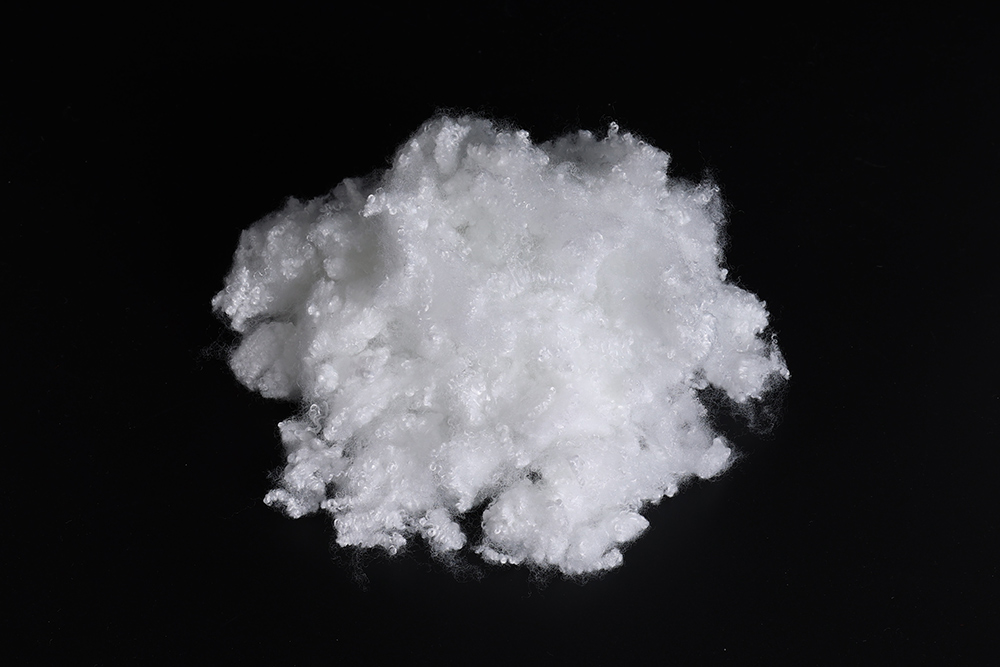
Virgin polyester is synthesized from controlled, standardized inputs, resulting in uniform denier, tenacity, and elongation across production runs. Recycled fiber inherits the variability of its source materials — contamination from colorants, adhesives, or incompatible polymer blends can cause inconsistent melt behavior and unexpected performance failures in precision applications.
Virgin polyester's intact, high-molecular-weight polymer chains deliver measurably higher tensile strength, abrasion resistance, and elastic recovery. Reprocessing degrades rPET's chain length, resulting in lower tenacity and reduced durability — a trade-off that is not viable in performance-critical end uses.
Virgin polyester's chemical uniformity enables even dye uptake and minimal lot-to-lot color deviation. Residual colorants and surface impurities in recycled fiber disrupt dye absorption, increasing shade variation between batches and adding correction costs downstream.
Virgin polyester provides a clean, chemically defined substrate for functional treatments such as moisture management, flame retardancy, and antimicrobial finishing. Impurities in recycled fiber disrupt treatment adhesion, reducing finish durability and creating compliance risk in regulated applications.
Virgin polyester offers a stable, scalable supply base with fully customizable specifications — denier, crimp, cut length — supporting high-volume manufacturing with low waste rates. Recycled fiber supply is subject to feedstock volatility that can constrain scheduling, force specification compromises, and erode the apparent cost advantage.
This is not an argument against recycled polyester as a category. For applications where performance thresholds are modest and sustainability credentials carry commercial value — packaging materials, basic woven fabrics, certain filling applications — rPET can be a sound choice.
However, procurement professionals should be clear-eyed about the categories where recycled fiber consistently underperforms:
In each of these segments, the performance variability inherent in recycled fiber is not a manageable risk — it is a liability. Sourcing decisions that prioritize the recycled label over material performance in these applications ultimately increase total cost of ownership through higher rejection rates, rework, and customer complaints.
The growth of recycled polyester reflects a genuine and important shift in how the industry thinks about material stewardship. That shift should be welcomed. But procurement decisions must be grounded in performance data, not narrative.
Virgin polyester fiber offers a combination of purity, mechanical performance, dyeability, functional finish compatibility, and supply chain reliability that recycled alternatives cannot yet replicate at equivalent specification levels. For applications where these properties matter — and in B2B supply chains, they frequently do — virgin fiber is not the legacy choice. It is the right choice.
The most sophisticated sourcing strategies are not those that default to recycled fiber across the board, but those that deploy each material where it performs best. Virgin and recycled polyester are not rivals competing for the same applications — they are complementary options, each with a defined role in a well-designed supply chain.