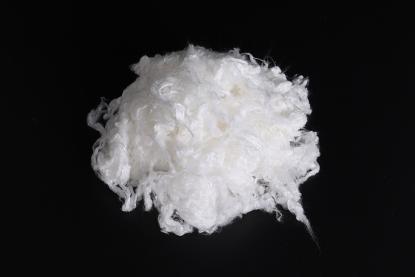

Dry breaking strength: ≥2.00 cN/dtex
Wet breaking strength: ≥1.10 cN/dtex
Dry elongation: 20.0±3.0%
Specifications: 1.33 dtex × 32 mm, 1.33 dtex × 38 mm, 1.33 dtex × 44 mm, 1.33 dtex × 51 mm, 1.67 dtex × 38 mm, or customized according to customer requirements.
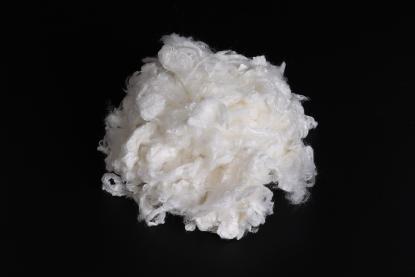
Dry breaking strength: ≥2.00 cN/dtex
Wet breaking strength: ≥1.10 cN/dtex
Dry elongation: 20.0±3.0%
Specifications: 1.33 dtex × 32 mm, 1.33 dtex × 38 mm, 1.33 dtex × 44 mm, 1.33 dtex × 51 mm, 1.67 dtex × 38 mm, or customized according to customer requirements.
Dry strength: ≥2.20 cN/dtex
Wet strength: ≥1.20 cN/dtex
Dry Elongation: ≥16%
Whiteness: M2 ±2 (M2 denotes whiteness center value; cotton-type ≥85%, medium-long-type ≥84%)
pH Value: 4.0–7.5
Water-Soluble Matter: ≤0.6%
Water Absorption Time: ≤10s
Specifications: 1.0D–3.0D, length adjustable per customer requirements
Dry breaking strength: ≥1.35 cN/dtex
Wet breaking strength: ≥0.60 cN/dtex
Dry elongation: 30.0 ± 3.0%
Linear density: 1.67–5.56 dtex
Residue on ignition: >28%
Daxin strictly adheres to international standards and has successively obtained ISO 9001 Quality Management System Certification (Certificate No. 00224Q24590R0M), ISO 14001 Environmental Management System Certification (Certificate No. CQM24S22902R0M), and ISO 45001 Occupational Health and Safety Management System certification (Certificate No. 00224E33162R0M).
Committed to social responsibility and customer needs, Daxin has successively obtained certifications, including FSC Chain of Custody (Certificate No. FSC-C197528) and STANDARD 100 by OEKO-TEX® (Certificate No. SHFB 028709 TESTEX).
This enables comprehensive ecological oversight across the entire supply chain—from raw material procurement to product sales—while practicing green development principles to deliver premium products to customers.
Daxin specializes in functional and differentiated viscose staple fibers. With an annual production capacity of 200,000 tons, we have established a research platform featuring a pilot line capable of producing 500+5000 tons of functional cellulose fibers annually. This enables the company to conduct multi-tiered, full-chain R&D—from small-scale trials and pilot-scale testing to large-scale production.
Daxin has successively developed a series of new products with high technological content and added value, including Anti-fcell flame-retardant fibers, Anti-Frayon flame-retardant fibers, Jutecell fibers, protein fibers, and phase change energy storage fibers (PCF). These innovations have generated significant and sustained social impact, establishing the company's leading position within the industry.
Unlike polyester staple fiber in other categories, viscose fiber is derived from natural cellulose (typically plant-based materials such as wood pulp or cotton pulp).
Viscose fiber is also known as rayon fiber.
The production of viscose fiber begins with wood pulp cellulose of over 90% purity. This is dissolved in sodium hydroxide to form alkali cellulose, which is then pressed and shredded into white flakes. These flakes are aged in oxygen before reacting with carbon disulfide to produce yellow flakes. The yellow flakes are dissolved and matured for several hours to achieve the viscosity and uniformity suitable for spinning. They are then filtered to remove gases and extruded through spinnerets. The extruded filaments are regenerated into rayon filaments in a sulfuric acid bath. Finally, these filaments are drawn, washed, and refined to form rayon fibers that can be further processed into various fabrics.
Therefore, it is a type of regenerated cellulose fiber.
| Advantages | Shortbacks |
| Soft and comfortable, like the cotton | Becomes weaker when wet |
| Excellent moisture absorption and breathability | Prone to wrinkles |
| Good drape and smooth appearance | Moderate durability and lower abrasion resistance |
| Bright, even dyeing performance | Sensitive to humidity and may deform easily |
| Made from renewable cellulose (biodegradable) | Chemically demanding production process |
| Blends well with other fibers | Requires careful washing and maintenance |
The production process for rayon is overly complex and requires dozens of different chemicals and textile manufacturing equipment, making it impractical for small factories to produce. In most cases, rayon is manufactured in large factories that often also can manufacture other types of fibers.
This is why you can trust Daxin—we are highly confident in our production capabilities and product quality.